Genetics Courses
Genetics courses can help you learn DNA structure, gene expression, genetic variation, and inheritance patterns. You can build skills in data analysis, laboratory techniques, and interpreting genetic information for research or clinical applications. Many courses introduce tools like CRISPR for gene editing, bioinformatics software for analyzing genetic data, and sequencing technologies that are essential for understanding genetic sequences and their implications in health and disease.
Popular Genetics Courses and Certifications
 Status: Preview
Duke University
Skills you'll gain: Molecular Biology, Biology, Biostatistics, Biotechnology, Environmental Science, Scientific Methods, Mathematical Modeling
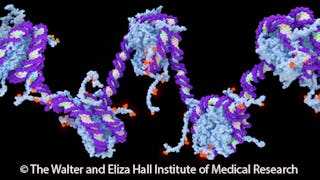 Status: Preview
The University of Melbourne
Skills you'll gain: Molecular Biology, Life Sciences, Oncology, Environment, Cell Biology, Biology, Medical Science and Research, Research Design, Nutrition and Diet
 Status: Free Trial
Johns Hopkins University
Skills you'll gain: Bioinformatics, Unix Commands, Biostatistics, Exploratory Data Analysis, Statistical Analysis, Unix, Data Science, Data Management, Statistical Methods, Command-Line Interface, Statistical Hypothesis Testing, Linux Commands, Data Analysis Software, Data Quality, Data Structures, Data Analysis, Computer Science, Molecular Biology, R Programming, Python Programming
 Status: Preview
University of Minnesota
Skills you'll gain: Mental and Behavioral Health, Social Studies, Psychology, Psychiatry, Medical Science and Research, Molecular Biology, Research Methodologies, Biology, Statistical Analysis, Case Studies
 Status: Preview
University of Illinois Urbana-Champaign
Skills you'll gain: Life Sciences, Molecular Biology, Biotechnology, Precision Medicine, Biology, Physiology, Sustainable Development, Environmental Science, Cell Biology, Microbiology, Biomedical Engineering, Research
 Status: Preview
McMaster University
Skills you'll gain: Precision Medicine, Molecular Biology, Bioinformatics, Pharmacology, Medical Science and Research, Biotechnology, Biochemistry, Laboratory Techniques, Healthcare Ethics, Science and Research
What brings you to Coursera today?
 Status: Free Trial
Johns Hopkins University
Skills you'll gain: Bioinformatics, Data Science, Molecular Biology, Data Analysis, Computer Science, Statistical Analysis, Computational Thinking, Biostatistics, Statistics, Software Engineering, Algorithms, Biology
 Status: Free Trial
Johns Hopkins University
Skills you'll gain: Oncology, Medical Imaging, Patient Education And Counseling, Diagnostic Radiology, Radiation Therapy, Molecular Biology, Diagnostic Tests, Clinical Trials, Pain Management, Preventative Care, Treatment Planning, Urology, Patient Treatment, Immunology, Epidemiology, Surgery, Cell Biology, Care Management, Biology, Pathology
 Status: NewStatus: Free Trial
Lecturio
Skills you'll gain: Molecular Biology, Biochemistry, Cell Biology, Pharmacology, Biology
 Status: NewStatus: Preview
University of Cambridge
Skills you'll gain: Intellectual Property, Law, Regulation, and Compliance, Medical Privacy, Biotechnology, Regulation and Legal Compliance, Legal Research, Life Sciences, Healthcare Ethics, Emerging Technologies
 Status: Free Trial
University of California San Diego
Skills you'll gain: Bioinformatics, Molecular Biology, Dimensionality Reduction, Unsupervised Learning, Applied Machine Learning, Data Analysis, Markov Model, Network Analysis, Biochemistry, Biotechnology, Life Sciences, Infectious Diseases, Microbiology, Statistical Analysis, Biology, Algorithms, Classification Algorithms, Data Mining, Data Preprocessing, Python Programming
 Status: Free Trial
University of Colorado Boulder
Skills you'll gain: Biological Engineering, Markov Model, Molecular Biology, Biotechnology, Bioinformatics, Simulation and Simulation Software, Mathematical Modeling, Engineering Analysis, Mathematical Software, Electrical Engineering, Engineering Design Process, Simulations, Biochemistry, Computational Thinking, Failure Analysis, Differential Equations, Cell Biology, Hazard Analysis, Technical Design, Chemical Engineering
In summary, here are 10 of our most popular genetics courses
- Introduction to Genetics and Evolution: Duke University
- Epigenetic Control of Gene Expression: The University of Melbourne
- Genomic Data Science: Johns Hopkins University
- Introduction to Human Behavioral Genetics: University of Minnesota
- Genomics: Decoding the Universal Language of Life: University of Illinois Urbana-Champaign
- DNA Decoded: McMaster University
- Introduction to Genomic Technologies: Johns Hopkins University
- Cancer Biology: Johns Hopkins University
- Molecular and Cell Biology: Lecturio
- Law and Genetics: University of Cambridge










